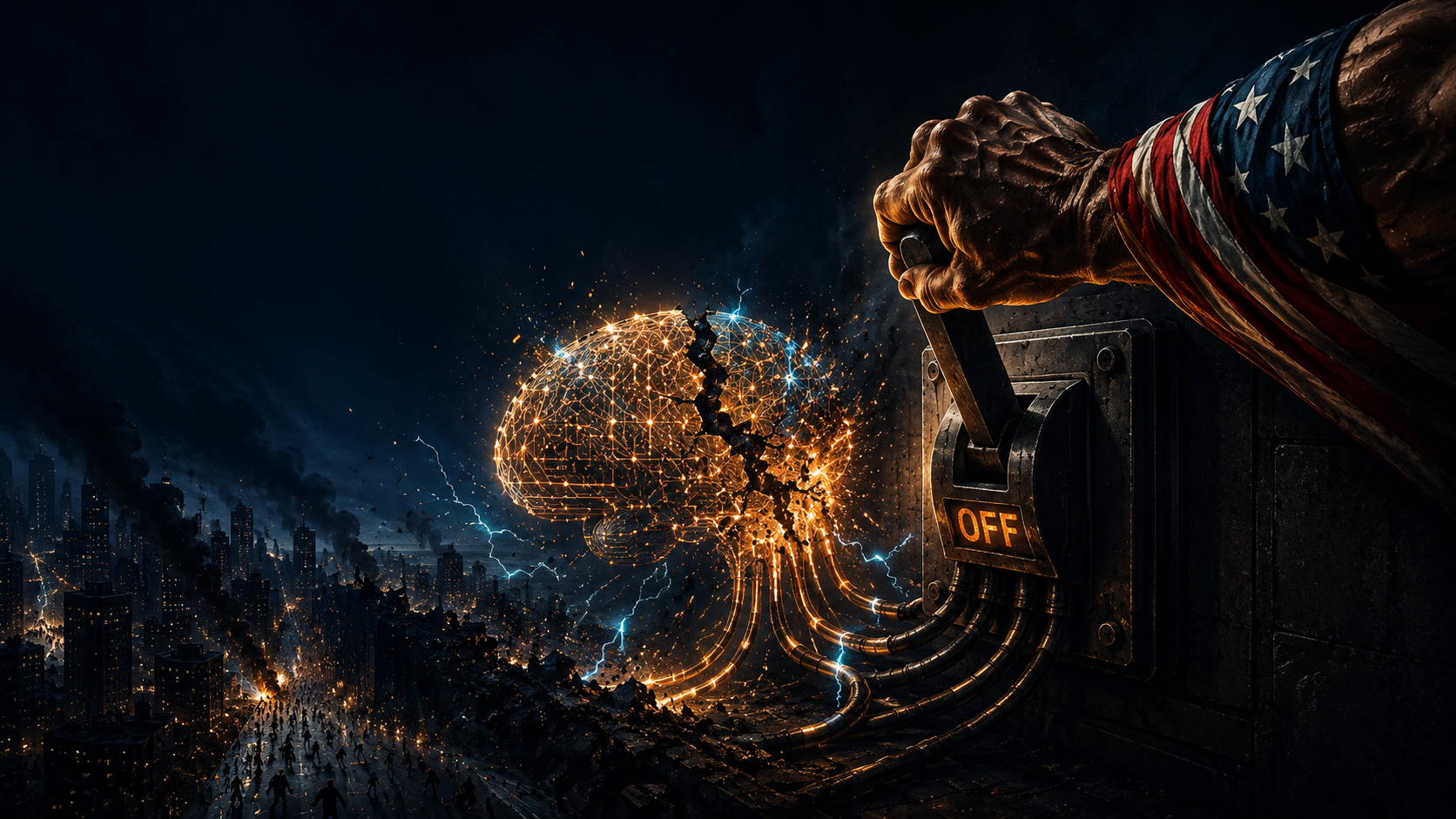
On June 12, a single letter from the US Commerce Department did what no outage, no cyberattack and no commercial dispute had managed to do before. It switched off two of the most capable AI models on the planet.
The directive ordered Anthropic to bar foreign nationals from Fable 5 and Mythos 5, citing national security. Anthropic, unable to gate users cleanly in real time, disabled both models worldwide. Notably, the order was about access outside the United States, yet the result was a global shutdown. Whether Anthropic did this to guarantee that no bypass would slip through, or to put visible pressure on the administration by letting everyone feel the consequence at once, is not clear and may never be. Anthropic itself called the action a misunderstanding and is disputing it.
I want to set the merits of that specific decision aside, because the merits are not the story. The legitimacy of the concern, the severity of the alleged jailbreak, who is right in the legal fight: all of that is noise relative to the one fact that should worry every executive and every government reading this.
With a single letter, a government blocked the use and export of a frontier AI tool, instantly and at global scale.
That is the headline. Everything else is commentary.
This is not about whether the decision was right
It is tempting to argue about the trigger. The capability the government appears to be worried about, reading a codebase and fixing software flaws, is something defenders use every day and that other models can already do. Anthropic makes exactly that point. But if we spend our energy debating whether this particular call was justified, we miss the structural lesson.
The structure is this. A capability that hundreds of millions of people and thousands of organisations had integrated into their operations on a Tuesday was gone by Friday night, by administrative fiat, with no transition window and no appeal in the moment. The off-switch was not theoretical. It was pulled, and it worked.
If your business continuity plan assumes that a core technology disappears only through bankruptcy, outage or your own choice to stop paying, you now have a new failure mode to model. Your vendor can be perfectly healthy, perfectly willing to serve you, and still be ordered to cut you off.
A precedent that should make everyone uncomfortable
For years, AI export controls meant one thing: hardware. Advanced chips, the equipment to make them, the people who design them. The logic was physical. You restrict the silicon, you slow the capability.
This is one of the first times that export-control authority has been aimed at a deployed commercial AI model rather than at chips or hardware. The object of control is now the intelligence itself, delivered over an API, not the machine that runs it.
The most striking detail, is that the order reached Anthropic’s own foreign-national employees. By restricting who inside the company can touch the model, the directive became, almost by accident, the first regulation on recursive self-improvement: a rule about which humans are allowed to use an AI to help build the next AI. We are now governing not just the export of a product, but the nationality of the people permitted to think with it.
If that principle generalises, the consequences are large. It is not difficult to imagine a near future where you must prove citizenship to access the most capable models, where engineering teams are reorganised around passports, and where the location of a developer matters more than their skill.
We have seen this movie before, and we know how it ends
In the 1990s, the United States classified strong encryption as a munition and controlled it under arms-export law. The intent was national security. The outcome was instructive.
Encryption research and product development moved offshore, because the rest of the world wanted strong cryptography and was perfectly capable of building it. US products shipped abroad with deliberately weakened, export-grade security, and those same weaknesses were still being exploited against real systems two decades later. Most lasting of all, the episode created deep and durable distrust of US-led cryptography, a suspicion that anything American came with a hidden constraint or a hidden door.
The model, had been declared a dangerous weapon. That is almost word for word the framing of the crypto wars, thirty years later, applied to a chatbot.
The lesson from cryptography is not that controls never work. It is that security-motivated controls on a general-purpose technology tend to push capability elsewhere, weaken the controlled product, and erode trust in the controlling nation, often for a generation.
The proof is already running
If anyone doubts that restriction breeds substitution, look at what chip controls did to China. The goal was to slow Chinese AI. The effect was to make domestic capability a national obsession, to pour state and private money into a homegrown stack, and to produce models that surprised the world by matching frontier performance at a fraction of the expected cost, engineered specifically around the constraints imposed on them.
Restriction did not stop the target. It motivated the target. That is the pattern, and it is exactly the pattern this episode will set in motion everywhere else.
Sovereign AI is the rational response, and it does not mean autarky
This is the wake-up call. Not for Anthropic, and not even really about Anthropic. It is a call for governments and serious organisations to invest in genuine sovereign AI capability: the ability to develop, run and depend on AI that cannot be switched off by a foreign administrative decision.
Sovereignty here is a spectrum, not a binary. It does not mean every country rebuilds a frontier lab from nothing. It means having enough of the stack, compute, data, models, fine-tuning and the talent behind them, that you are never a single letter away from losing a capability your society now depends on. The objective is to be technically and financially independent enough to negotiate from strength rather than from dependence.
This is not science fiction. Switzerland already has Apertus, a fully open, transparent, multilingual model released by EPFL, ETH Zurich and the national supercomputing centre, deployable on sovereign Swiss infrastructure, with its weights, data and training recipe all in the open. Europe has Mistral and a continent-wide push toward AI infrastructure of its own.
The clearest example, though, is the UAE, which has treated sovereign AI as a national project for the better part of a decade. It became the first country in the world to appoint a Minister of State for Artificial Intelligence, back in 2017, and published a National AI Strategy 2031 long before most governments were paying attention. It built a national champion in G42, a research base in the Technology Innovation Institute whose Falcon models are open-weight and genuinely home-grown, and a dedicated talent engine in the Mohamed bin Zayed University of Artificial Intelligence, the world’s first university devoted entirely to AI. On the infrastructure side, the Stargate UAE compute cluster in Abu Dhabi ranks among the most ambitious AI facilities anywhere, and the country is investing at sovereign-wealth scale in its own compute, its own models and its own Arabic-language capability, placing it among the largest single national bets on sovereign AI in the world. Few nations have moved this deliberately to make sure the intelligence their economy runs on is built, trained and hosted at home.
Other examples such as DeepSeek in China and Mistral in Europe show this strong trend.
A note of realism is warranted, and it sharpens the urgency rather than softening it. Independent analysis shows that most national AI projects today still rely heavily on US technology, and that the large majority of so-called sovereign initiatives involve at least one foreign partner. In other words, sovereignty is still mostly an aspiration. The gap between the ambition and the reality is exactly the gap that an event like this one will force everyone to close.
The price we will pay, and why it is still worth paying
I have no illusion that this is free. The world is about to spend an enormous amount of effort replicating, rebuilding and imitating capability that already exists, instead of collaborating to push the frontier forward together.
Between the crypto race, the AI race and the quantum race now running between countries and between continents, fragmentation is the likely future. We will duplicate. We will reinvent. We will build parallel stacks that do not talk to each other. As an engineer, that waste genuinely pains me, because the faster path for humanity is the shared one.
But fragmentation is the lesser risk. A single point of dependency that a foreign government can sever on a Friday evening is the greater one. Given the choice between the inefficiency of building your own and the fragility of being switched off, any serious organisation, and any serious country, has to choose resilience.
The off-switch is no longer hypothetical. We watched it work. The only rational response is to make sure that, next time, it is not your capability on the other end of the wire.